 |
Six of our EGRET-AAA DCs had the pleasure to present their work for the first time at the Dutch Ophthalmology PhD Students (DOPS) conference “Expanding HorEYEzons.” in Nijmegen, Netherlands on 1 – 2 November 2024. At this conference they were able to discuss their results with other PhD students in their field. Ana Carolina, Giulia, Nasim, Pouneh, and Federica presented a poster and Lloyd gave an oral presentation. |
Ana Carolina’s ATOH knockout retinal organoidsAna Carolina presented her posted called “Development and characterization of ATOH7 CRISPR Knockout Retinal Organoids as a model for Glaucoma” where she showed how she successfully generated and differentiated ATOH7 knockout clones and characterized them on a genomic, transcriptomic, proteomic, and functional level. |
 |
 |
Giulia showcased the growth of FOXC1-mutated retinal organoidsFOXC1 is a gene in which mutations are linked to glaucoma. Giulia is investigating its role in the glaucomatous retina by growing FOX1-mutated retinal organoids to mimic what happens within our body. She presented how she was able to differentiate the mutated organoids into retinal organoids that produce retinal ganglion cells with axonal extension capabilities. |
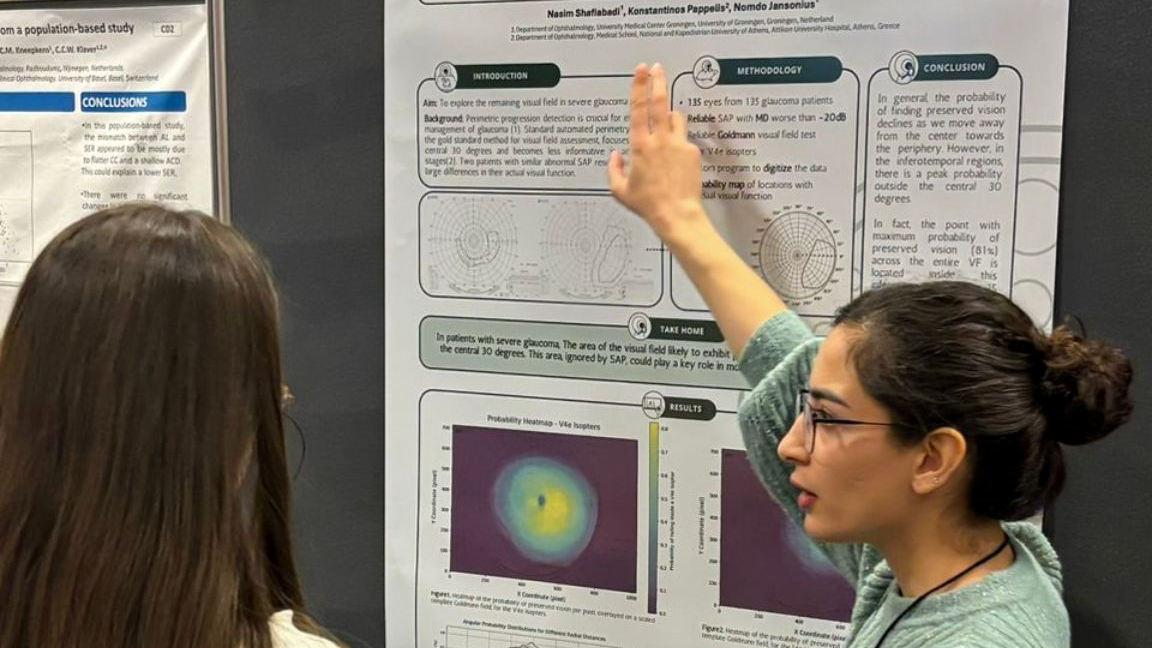
Nasim tries to see what standard automated perimetry can’t seeStandard automated perimetry (SAP) is the golden standard to monitor glaucoma progression. Areas outside the central 30 degrees of vision are crucial in monitoring late stage glaucoma but are invisible to SAP. Nasim is using Goldmann perimetry to better understand which visual areas outside the central 30 degrees are most likely preserved in late stage glaucoma patients for better monitoring. |
 |
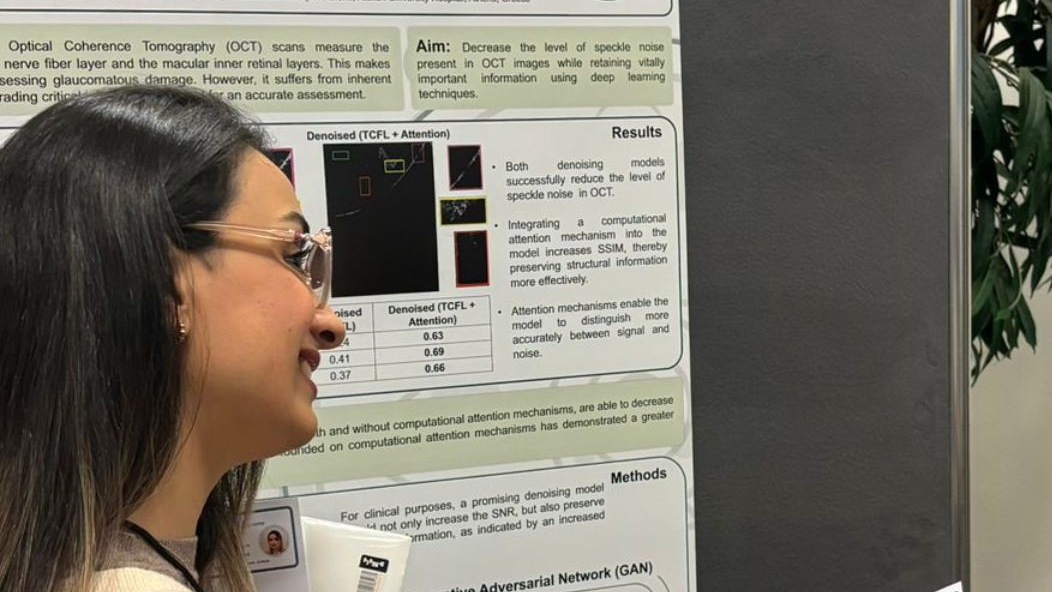 |
Maryam is cleaning up OCTsOptical Coherence Tomography (OCT) scans can make very clear pictures of the retina, but they have a problem. These images can be very noisy. Luckily Maryam is coming to the rescue. She has developed a deep learning network that can denoise OCT scans while preserving clinically relevant information using attention mechanisms in her neural network. |
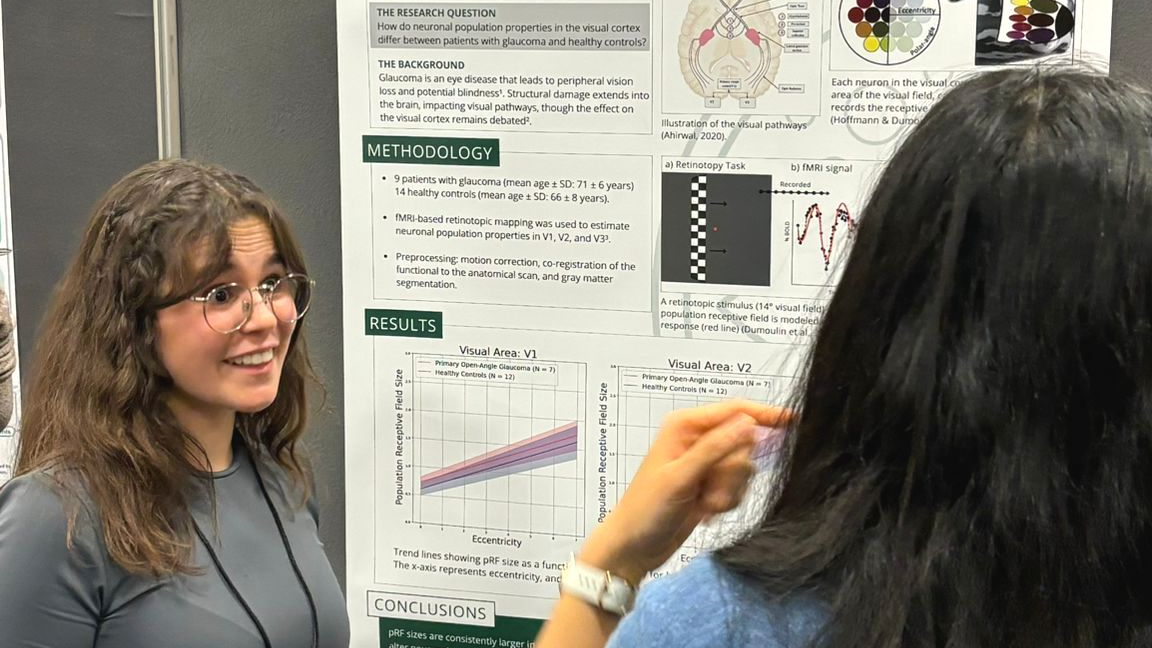
Federica investigated glaucomatous brains see the worldGlaucoma has an impact on the connectivity of the brain. By conducting fMRI scans, Federica investigated how neuronal populations in the brain perceive our visual field. She has shown that the size of glaucomatous population receptive fields are larger in people with glaucoma than in healthy controls. |
 |
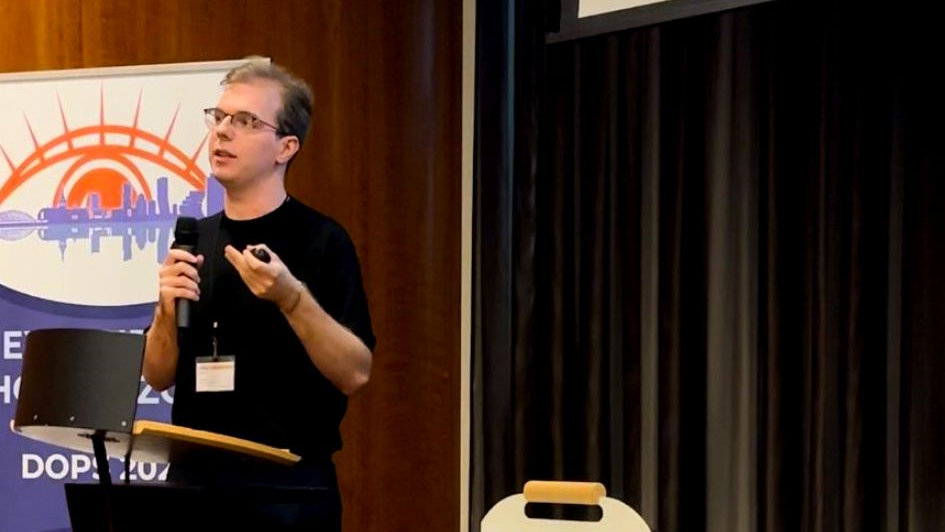 |
Lloyd’s quest to describe glaucomatous brain damageAt DOPS there were also oral presentations. Lloyd gave a 9-minute presentation “Profiling white matter microstructure along the primary visual pathway to assess neurodegeneration in glaucoma”. He has developed an algorithm that can quantify structural damage along white matter tracts in the visual pathway. 🏆Lloyd received the Best Oral Presentation award for this talk! |